How to Help Your Child Start Writing Without Frustration
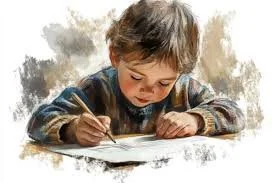
Last year, my son didn't write me a Mother's Day card. He flat out refused when his dad brought the card into his room.
Later that day, after many tears from both him and me, he said something to me that I'll never forget.
"Mom, I can't write. My sentences are too short."
And then I recalled the various thank you cards we had received for birthday parties, when my son noticed another child's writing and said, "How does she write so many sentences? How are they so long?"
That day I realized my fear of pushing my children too hard as a teacher had come back and bit me. I now had the opposite problem. My son didn't hate writing because he was lazy or resistant. He hated writing because no one had ever shown him how to make a sentence grow.
So that day, Mother's Day 2025, I sat down beside him and gave him a simple prompt: What do you love about your mother?
And then I taught him two things that changed everything.
The Two Tools That Unlock Writing
The first is something writing teachers call the FANBOYS — for, and, nor, but, or, yet, so. These are coordinating conjunctions, the words that connect two complete thoughts into one longer, more sophisticated sentence. Most children write in short, simple sentences not because they have nothing to say, but because no one has shown them how to link their ideas together.
The second is the appositive phrase — a short description placed directly after a noun to add detail and color. Instead of writing "I love my mom," a child can write "I love my mom, a patient and funny person who always knows what to say."
I modeled it for him using himself as the subject:
I love my son, my curious and compassionate 8-year-old, because he can make me laugh and brings me coffee when I'm working, so every morning with him feels a little brighter.
He read it. He smiled. And then he picked up his pen.
After a five-minute mini-lesson at the kitchen table, my son wrote his Mother's Day card, on his own, with a smile on his face.
Writing Doesn't Have to Be a Big Deal
That afternoon taught me something I already knew as an educator but had forgotten as a mother: writing doesn't have to be a big production filled with stress and tears. It doesn't require a special curriculum, a lengthy assignment, or a dedicated writing block.
It requires someone to sit beside a child and show them one small tool.
Writing grows in small moments. At the kitchen table. In the car. In the margin of a thank you card. When we stop waiting for the perfect time and start offering the right tool at the right moment, children discover something surprising: they actually have a lot to say.
They just needed someone to show them how.
Try This at Home
The next time your child needs to write something, a thank you card, a birthday message, a school assignment, try this:
1. Give them a simple prompt. Keep it personal and low stakes.
2. Write a model sentence together using them as the subject.
3. Introduce one FANBOY conjunction and show them how it connects two ideas.
4. Let them try. Don't correct. Just encourage.
You don't need to be a writing teacher to do this. You just need to sit beside them.
If your child is struggling with writing and you'd like more personalized support, feel free to reach out. This is exactly the kind of work I do with students every day, and it never gets old watching a child realize they have more to say than they thought.
— — —
Rachna Deepa Dharna is a reading specialist, writing tutor, and founder of Revive Tutoring. She works one-on-one with K–12 students on reading, writing, and everything in between. Her approach is warm, structured, and built around each child's specific needs, because strong readers become strong writers, and strong writers become confident thinkers. Learn more at revivetutoring.com.